

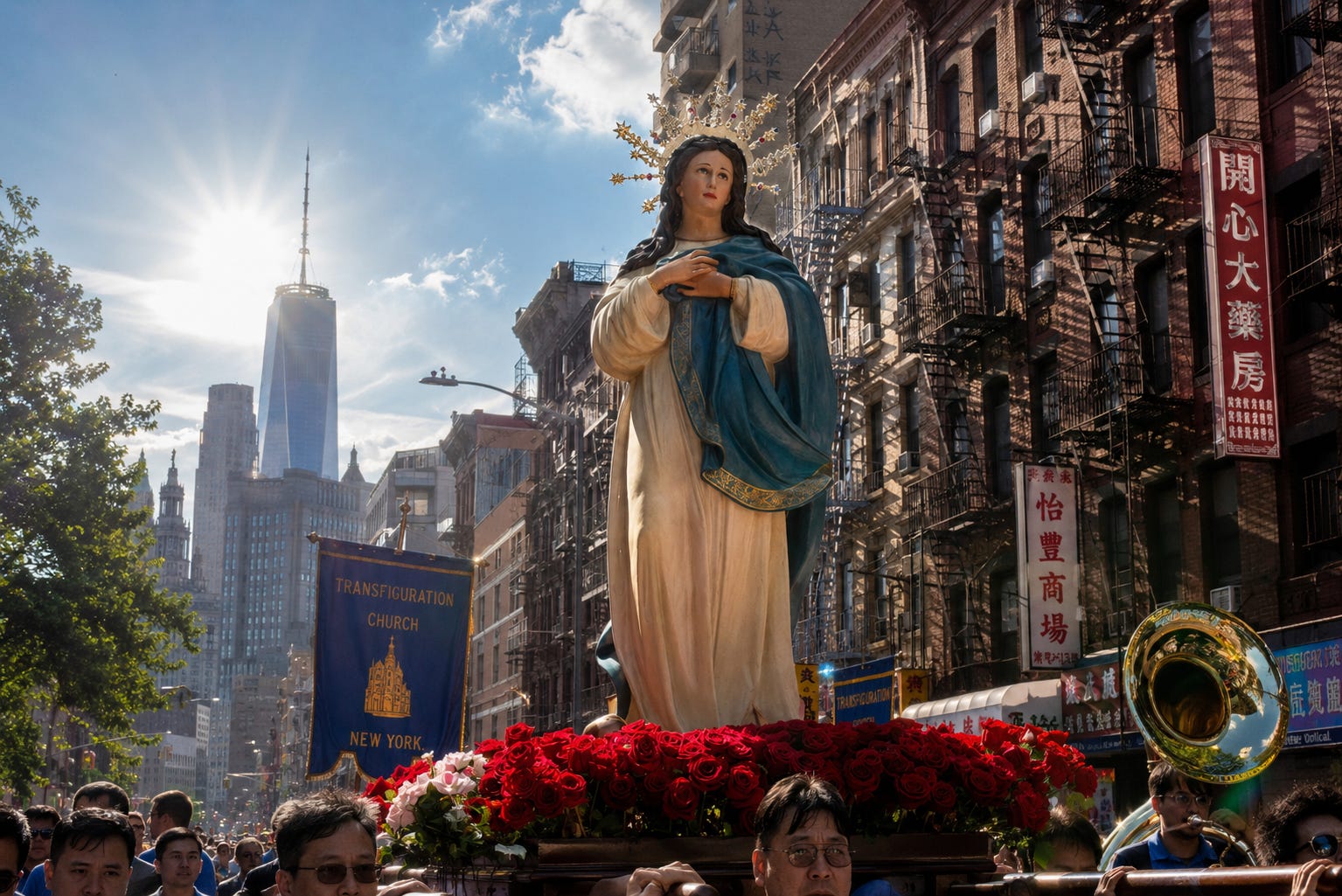
Every time I walk south on Mott Street, I feel as though I’m walking backward through time.
Long before I knew the history beneath these streets, I knew this part of Manhattan through my father. He would take me to Parisi Bakery for bread, Jefferson Market for meat and Balducci’s for fruit before we made our way to South Street and my beloved grandmother’s apartment for a feast.
Near Mott Street’s southern end, the sidewalks narrow. The smell of noodles, bao and Chinese pastries drifts from storefronts while signs bearing Chinese characters climb the brick facades.
It’s unmistakably New York, but also a world unto itself, one of those rare corners where another culture has not merely survived, but taken root.
Chinatown.
There, where Mott meets Mosco, the Church of the Transfiguration comes into view.
It’s not grand in the way St. Patrick’s Cathedral is grand. No broad avenue before it, and no soaring spires rise over the city. Built of rough fieldstone, it holds its ground amid the daily tumult of Chinatown.
At the risk of starting an argument with half of New York…I think it may be the most interesting church in the city.
Not because it is the largest or most ornate.
Because of what it has witnessed.
The building dates to 1801. The Catholic Parish of the Transfiguration moved into it in 1853 and went on to serve successive waves of Irish, Italian and Chinese immigrants. Today, Mass is celebrated there in Cantonese, Mandarin and English.
Streets have been renamed. Buildings have risen and vanished. Entire populations have arrived, struggled, prospered and moved on.
But the church has remained.
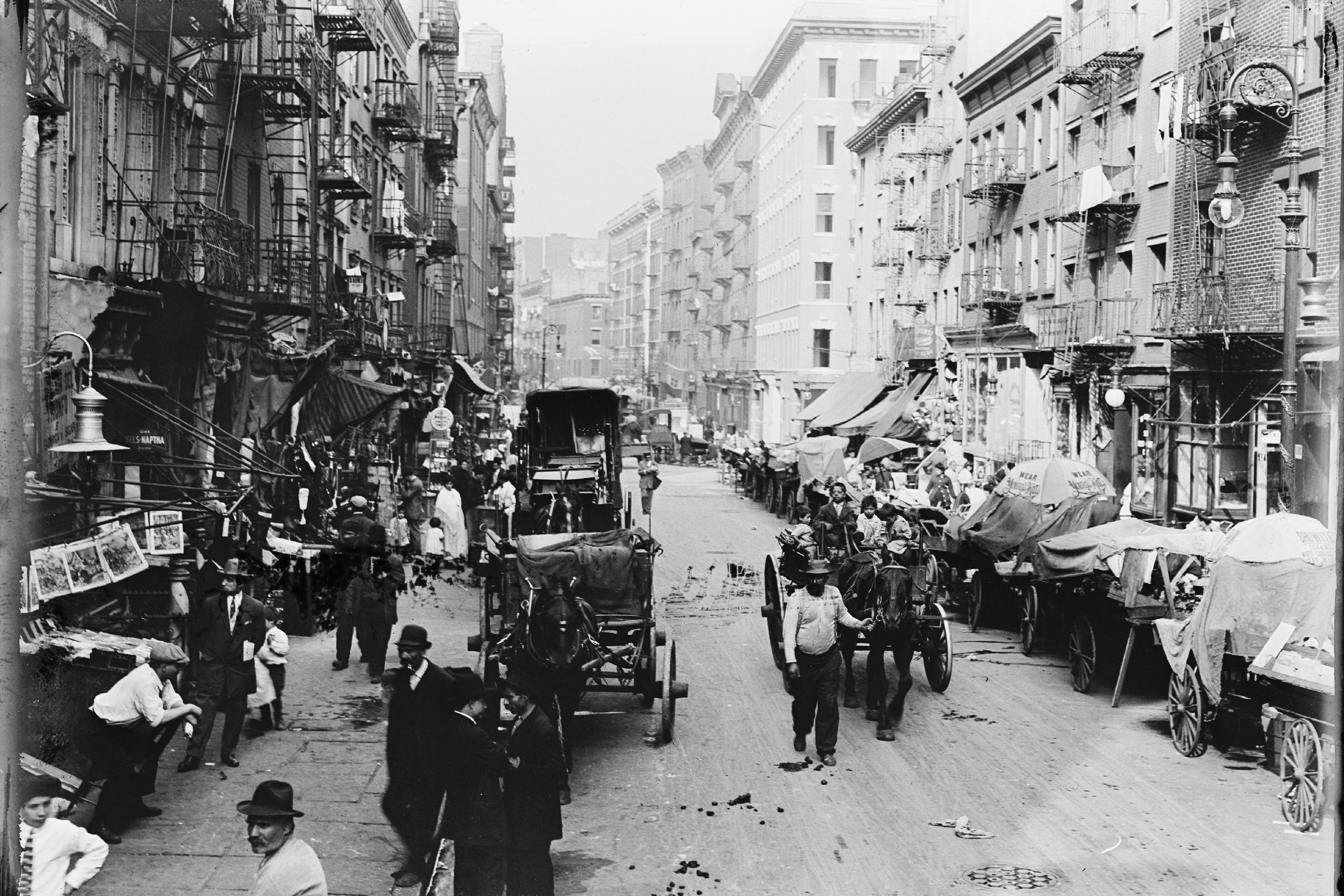
The City Beneath the City
A short walk west lies the former site of Collect Pond, a spring-fed source of fresh water for early New Yorkers.
Industry fouled it so badly that the city drained its waters toward the Hudson through the canal that gave Canal Street its name, then filled the pond by 1811. The reclaimed ground proved unstable. Buildings shifted, streets became muddy and poorer residents and immigrants moved into cheap housing around the five-way intersection that gave Five Points its name.
By the middle of the 19th century, the neighborhood was infamous for poverty, disease and violence. Irish refugees crowded its tenements. Italians came later, followed eventually by the Chinese community that transformed much of the old neighborhood into Chinatown.
Popular history remembers Five Points for its gangs, saloons and lurid alleys.
But history has a habit of remembering criminals more clearly than it remembers mothers.
The people there were families building lives under brutal circumstances. They fell in love. Children were born. The sick were cared for, and the dead were mourned.
Within the stone walls of Transfiguration, lives were joined, blessed and commended to God.
If its walls could speak, they would tell stories of heroism, horror and heartbreak. They would also testify to the words of St. Paul:
“Where sin increased, Grace abounded all the more.”
A Story Carried Across an Ocean
Transfiguration is sometimes called the “Church of Immigrants.” Its languages and faces have changed, but people have always entered looking for belonging, carrying their devotions, traditions and saints.
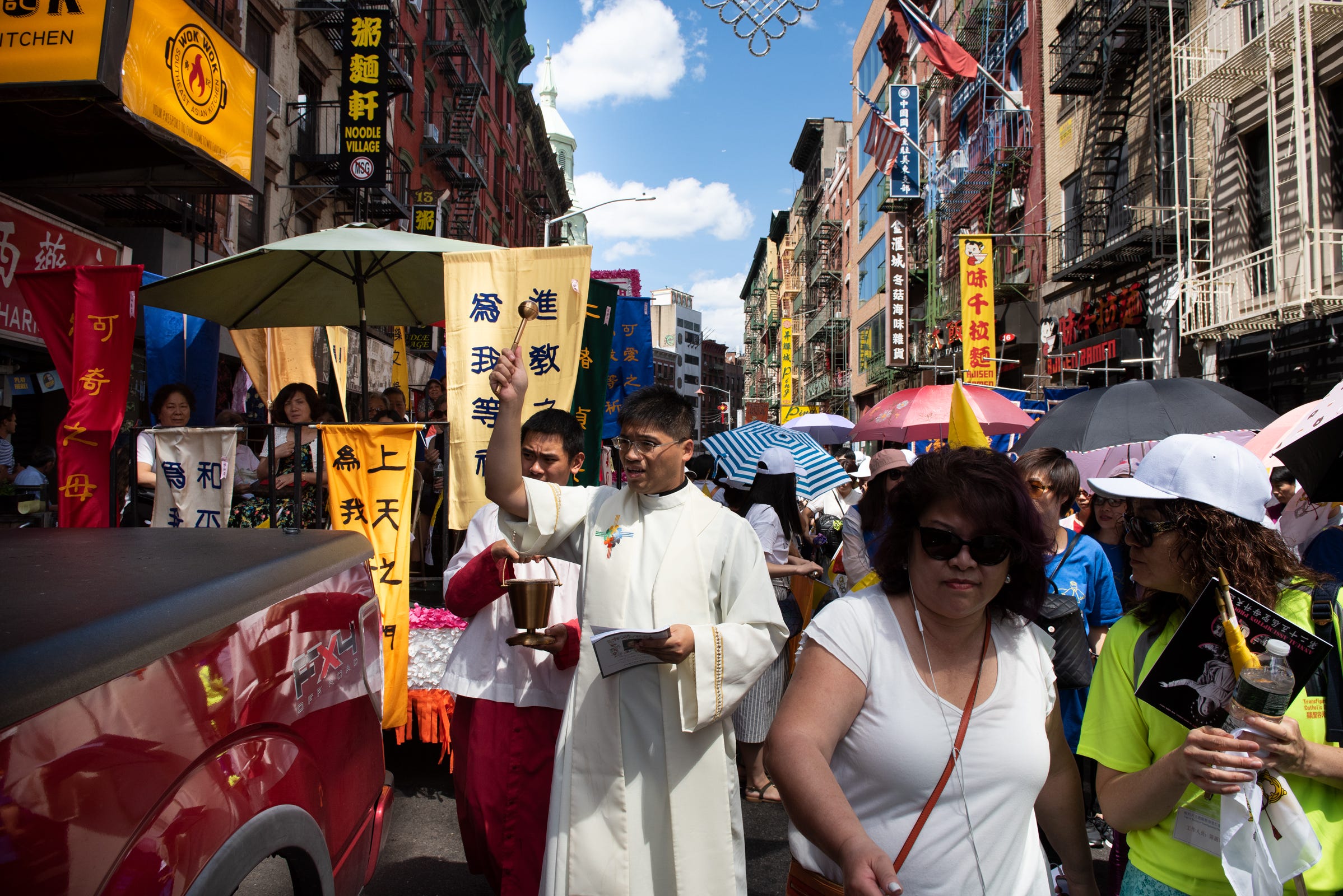
Perhaps no event reveals that history more clearly than the annual procession for the Assumption of the Blessed Virgin Mary.
The first time I photographed it, it seemed to take place on the hottest day of the year. Much to my dismay, that pattern repeated itself every time after without fail.
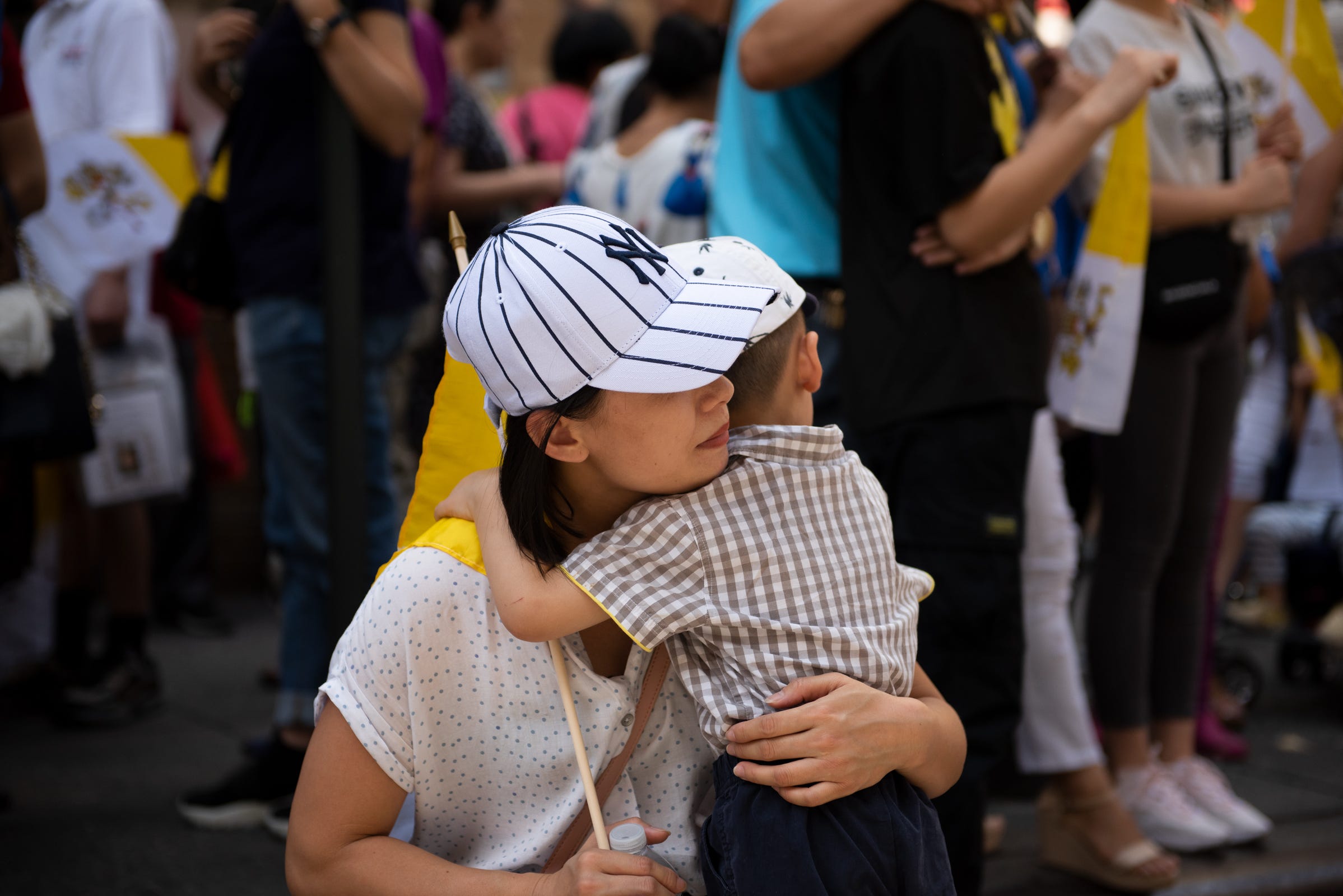
After Mass, the Chinese Catholic community poured into the streets. Banners rose above the crowd. The faithful carried an image of the Blessed Mother as a brass band played and prayers were offered in Cantonese beneath the blazing August sun.
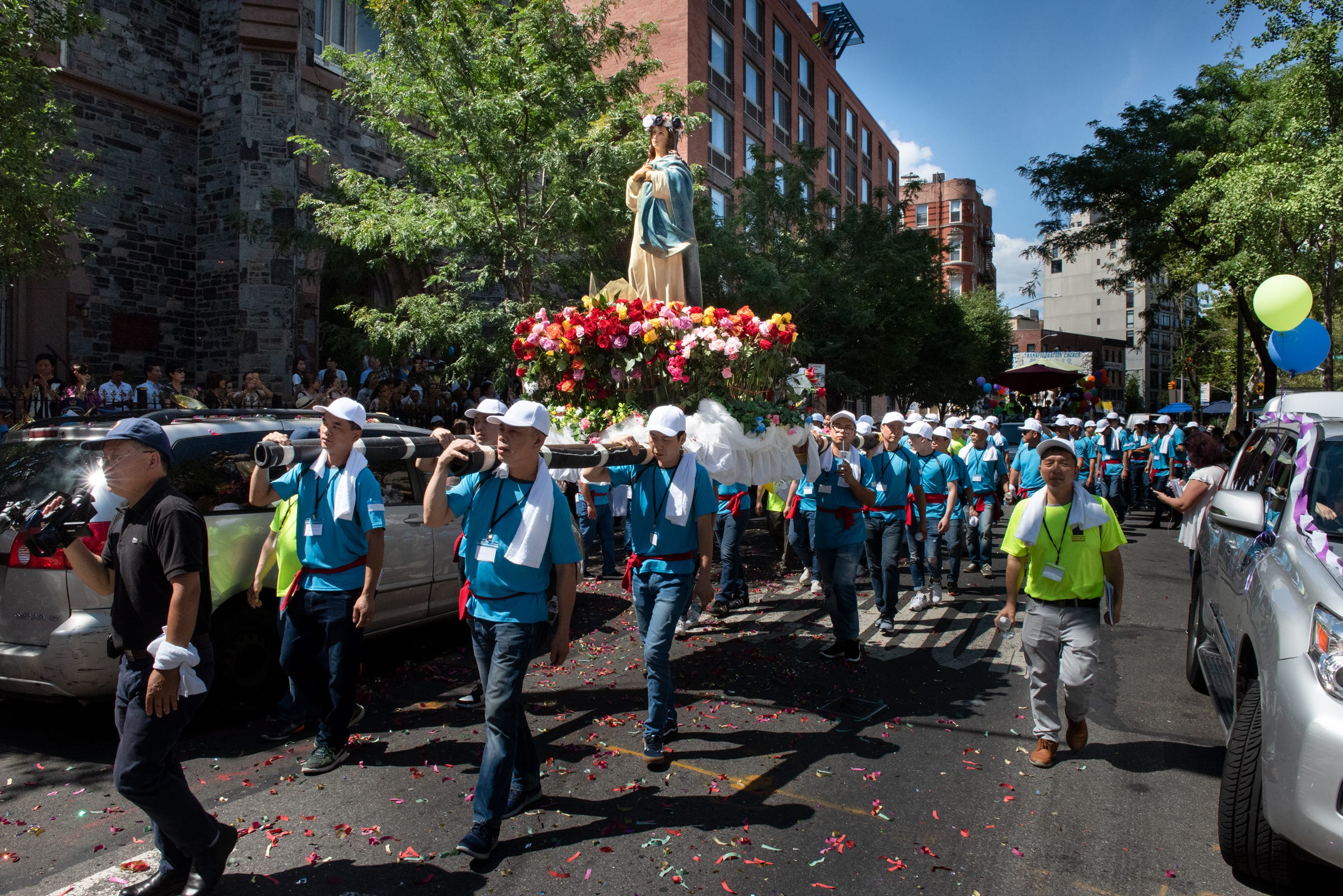
By the time we returned, I was drenched in sweat and exhausted.
As I trudged back up Mott Street toward the air-conditioned sanctuary of my car, an elderly Chinese man stopped me. He took me by the arm and pointed toward another man resting on the stoop of a nearby brownstone.
“You talk to him! You talk to HIM!” he insisted.
So I sat beside the man and opened another bottle of water. His face was deeply lined, but his smile was gentle and warm.
Then he began.
He spoke of a forest thousands of miles away.
Of a procession.
Of oppression.
And of freedom.
And of how, in 1994, it all found its way here—to Mott Street.
He spoke of Catholics in Fujian Province who practiced their faith where public religious activity could draw the attention of authorities. According to his recollection, the Assumption was less familiar to local officials than Christmas or Easter and therefore offered an opportunity to gather quietly as a community.
After midnight, they would make their way into the forest and hold a candlelight procession in honor of the Blessed Mother.
His account was oral history, a memory carried across an ocean, but its broad contours fit the documented record.
Catholicism has deep roots in northeastern Fujian, where Spanish Dominicans arrived in the 17th century. Local communities survived repeated suppression, including the Maoist era, preserving the faith within families and homes.
By the late 1980s and early 1990s, migration from Fujian to New York was rising. Some came through dangerous smuggling networks, burdened by enormous debts.
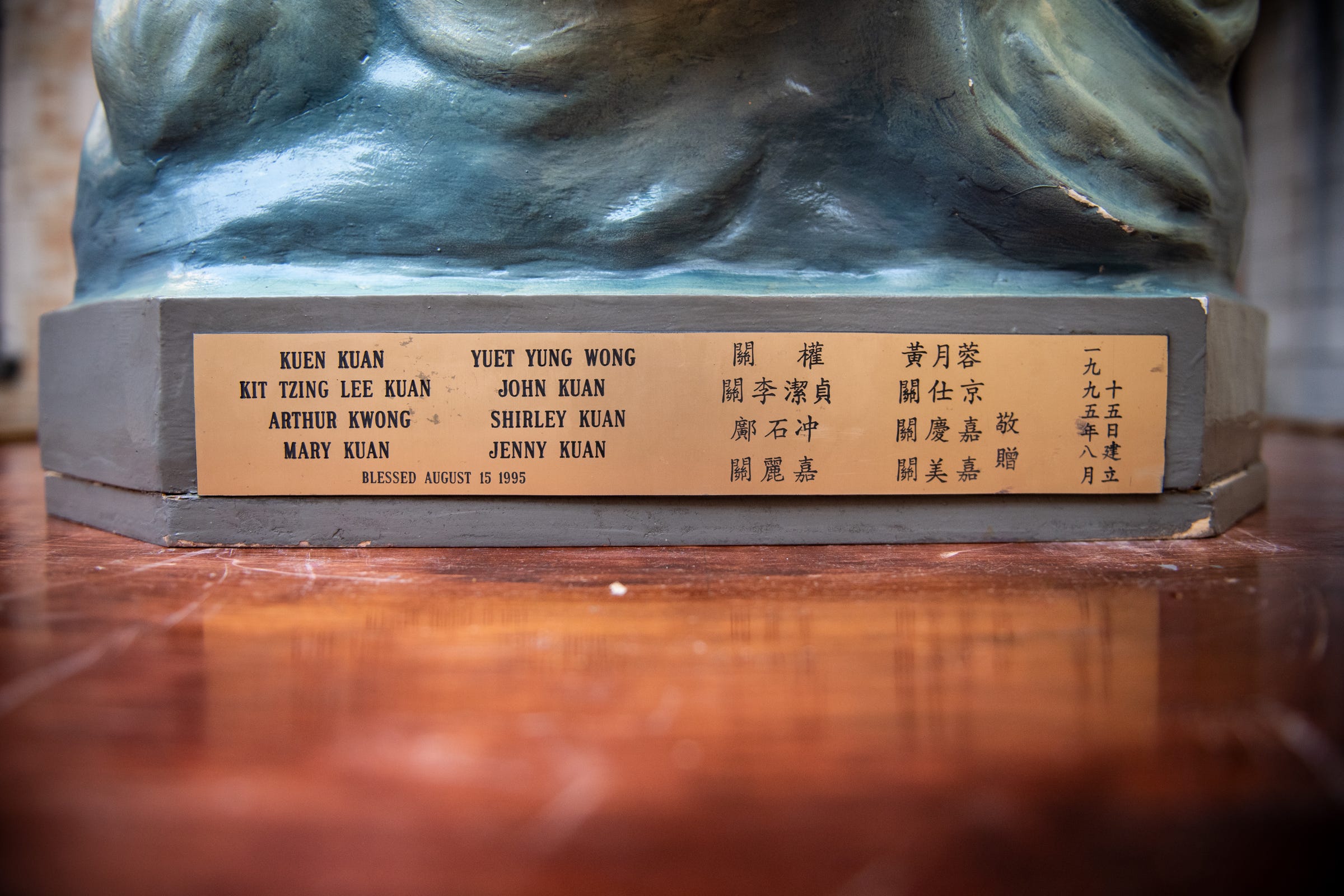
Among them was a small group of Catholics who found a spiritual home at Transfiguration. In 1994, they asked the parish to help bring their Assumption devotion into the streets of their new city.
This time, they would not have to wait until midnight.
They would not have to disappear into a forest.
They would walk in daylight.
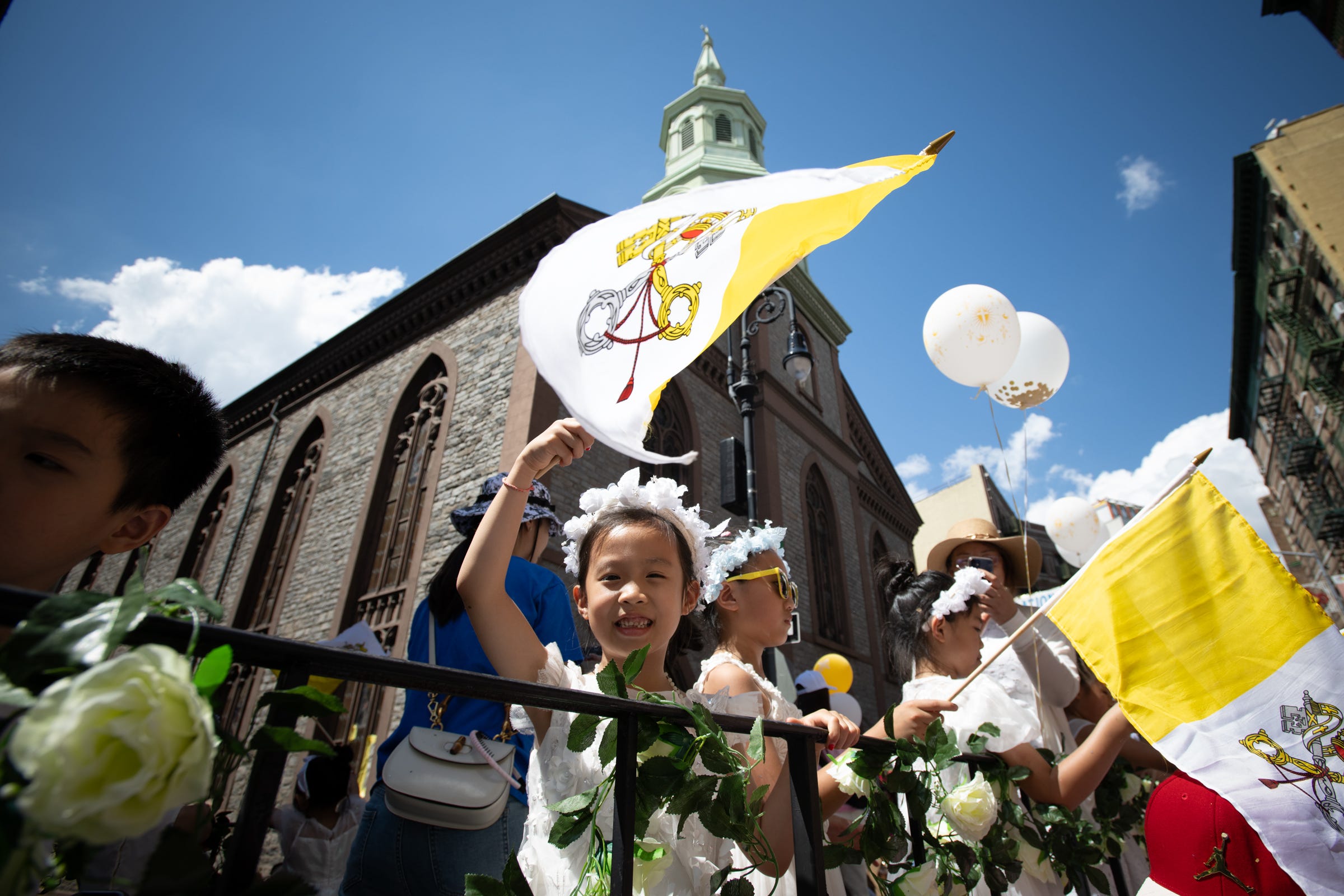
From Fujian to Chinatown
What began as an expression of faith and gratitude among Fujianese immigrants grew into one of New York’s largest and most distinctive Marian processions.
For several hours each August, Chinatown becomes an extension of the church. The image of Mary passes apartment windows, restaurant kitchens, storefront shrines and intersections ruled by delivery trucks, buses and the horns of the impatient.
Some join their hands in prayer. Others watch from doorways. Still others raise their phones, aware that something unusual is happening.
The procession is unmistakably Chinese and unmistakably Catholic.
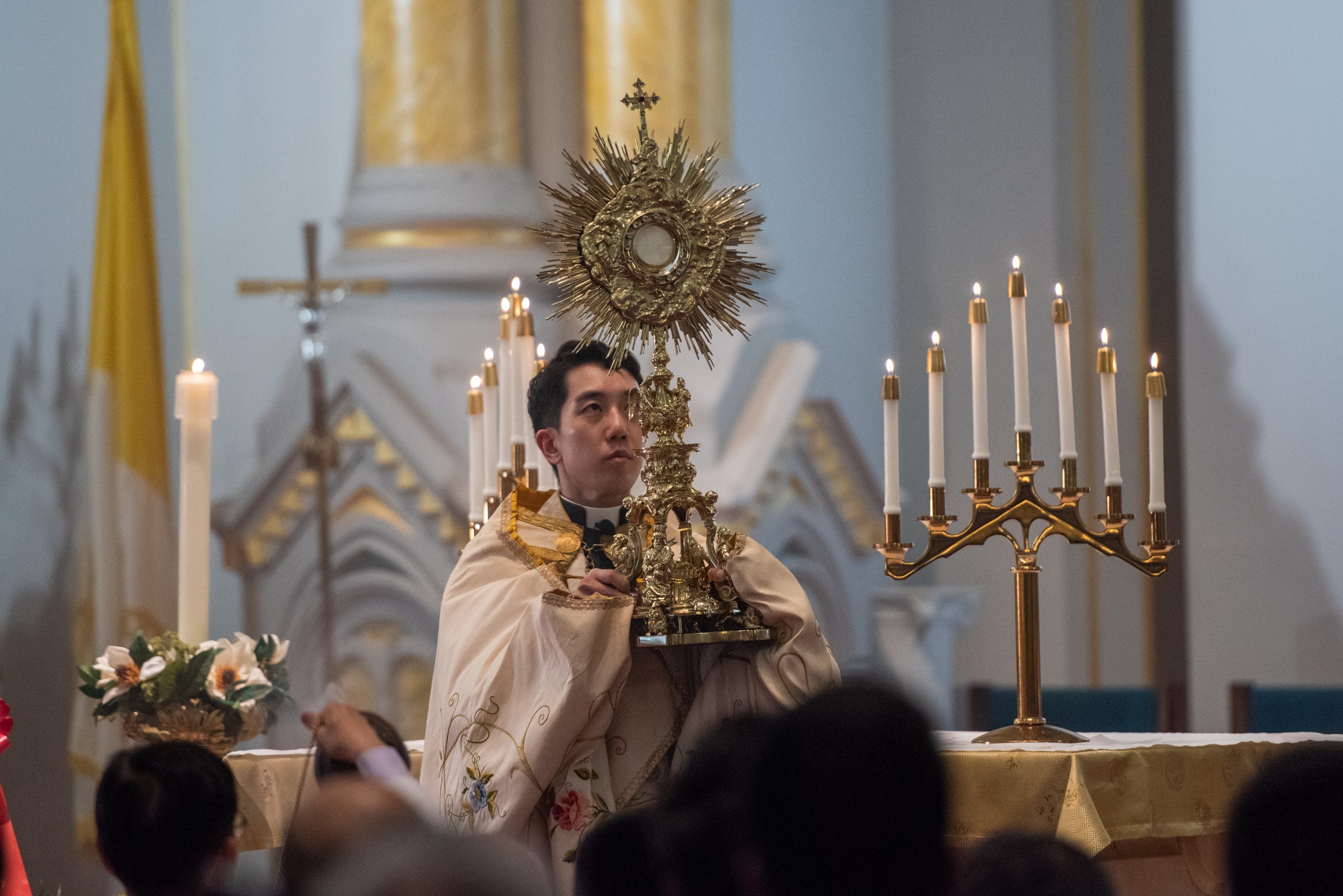
It’s also unmistakably New York.
People arrive carrying their story from another place. Their language, grief, food, songs and saints. They build a home without entirely surrendering the one they left behind. Eventually, their story becomes the city’s story.
And the streets remember.
There’s nothing sentimental about religious persecution, human smuggling, poverty or exile. But Christianity makes a more radical claim: suffering does not have the final word. Grace can enter wounded places. Faith can survive conditions designed to extinguish it. Something once hidden in fear can one day be carried openly through the streets.
That’s what happens each August at Transfiguration.
A devotion preserved across generations is proclaimed in the heart of New York City. A hymn once whispered is played by a brass band.
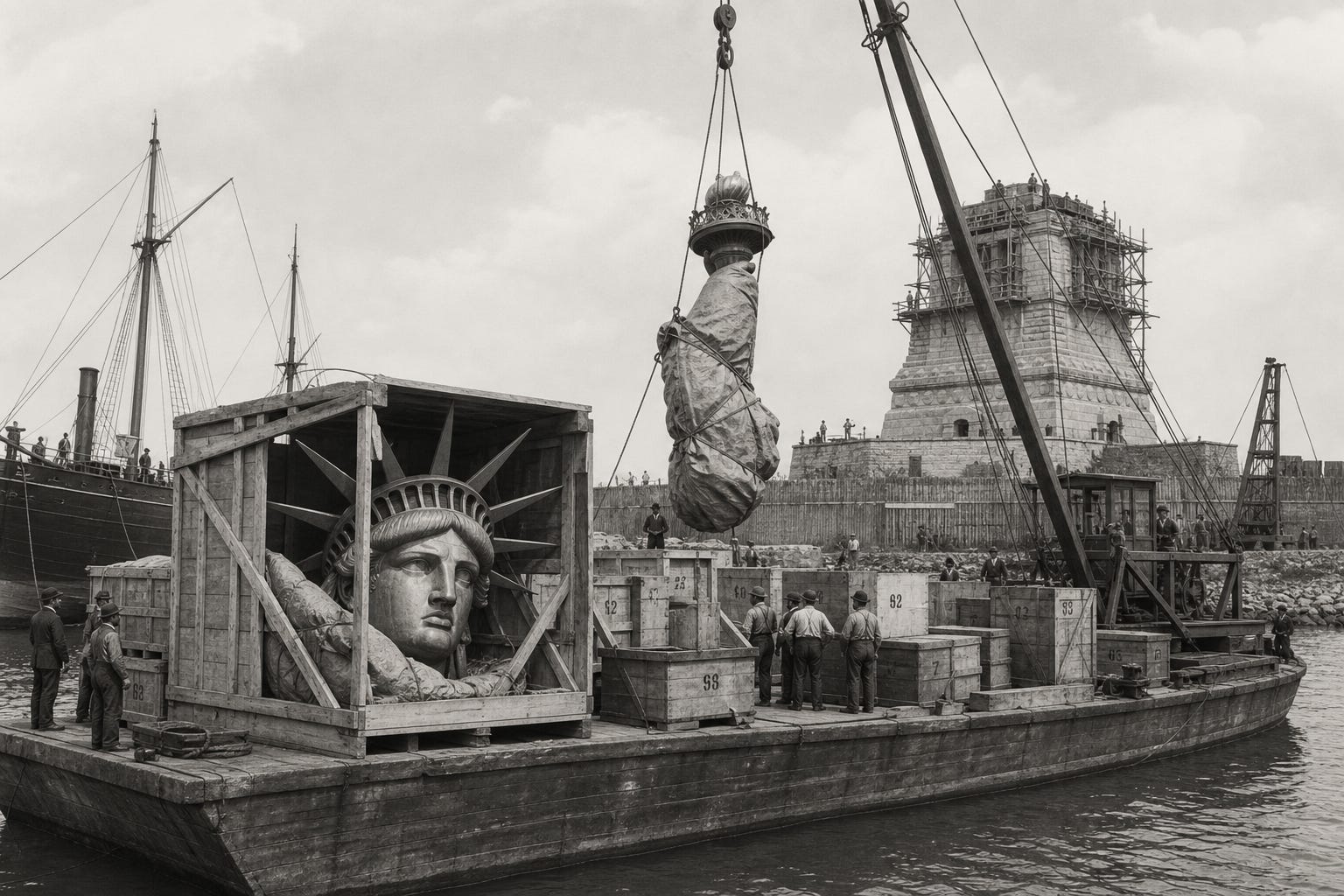
The city’s harbor is guarded by the image of a woman holding a torch, welcoming those who come in search of liberty.
But on an August afternoon in Chinatown, another woman is carried through the streets by people exercising that liberty.
One stands at the gate of the city as a promise.
The other is borne through the city in thanksgiving.
And somewhere between them lies the immigrant story of New York: departure and arrival, suffering and hope, the memory of one home and the difficult building of another.
At the corner of Mott and Mosco Streets, the old stone Church of the Transfiguration remains.
It doesn’t speak.
It witnesses.
And each year, when the Blessed Mother passes outside its doors, another chapter is written.
Once upon a time on Mott Street.
To be continued…
Thanks for reading! This is a truly independent, reader-supported periodical. Your support is crucial. If you are able, please consider a paid subscription or making a ‘Patron of the Arts’ donation of any amount. By doing so, you are not just supporting this effort; you’re a vital part of this mission.
You have my heartfelt thanks for your generosity and support, and please keep me in your prayers, and know of mine for each of you. God Bless, Jeff