

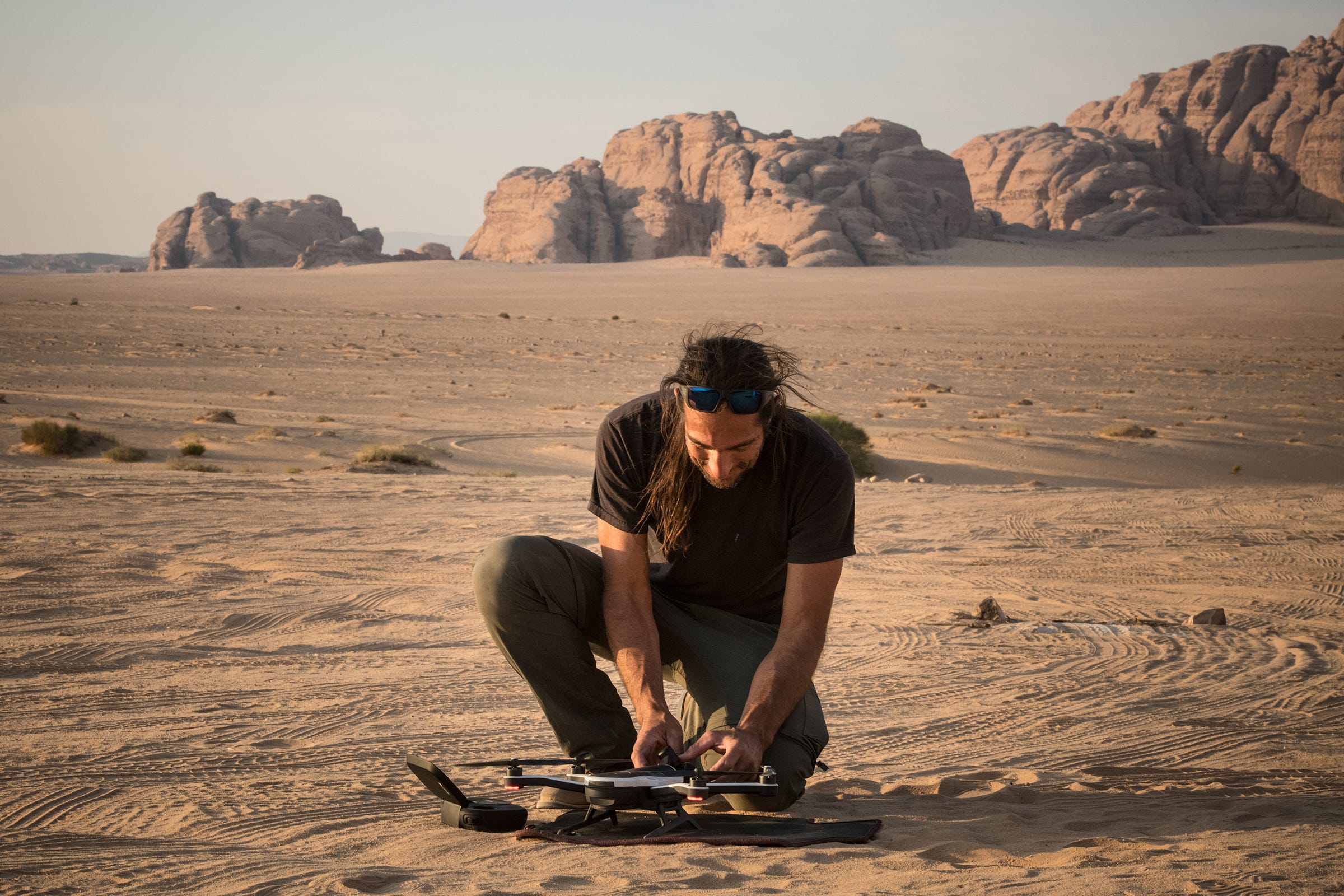
Adventure.
I’ve always admired those who have gone out to conquer the wilderness.
Those who crossed oceans without knowing what waited beyond the horizon. Those who descended into the depths of the sea, reached for the heights of space, or planted their boots upon the summits of the world’s great mountains.
Edmund Hillary and Tenzing Norgay standing on the roof of the world.
Amelia Earhart alone above the Atlantic.
Ernest Shackleton watching the Endurance disappear beneath the Antarctic ice, then setting off across 800 miles of murderous ocean in a 22-foot boat because the lives of his men depended upon it.
These are the stories that captured my imagination as a kid.
The idea of moving forward into the unknown… not knowing what’s waiting… writing an unscripted story moment by moment, minute by minute.
Some explorers are driven by curiosity. Others by the pursuit of knowledge or the desire to understand more about this magnificent universe God created. Still others simply possess that mysterious restlessness that makes an unexplored horizon almost impossible to resist.
And we owe them a debt.
They risked their lives, resources, and reputations to bring the rest of us knowledge, inspiration, and a slightly larger understanding of the world we inhabit.
For most of my life, I thought that was adventure.
And if you had asked ten-year-old Jeff whether the Catholic Church might actually be the greatest repository of adventure in the history of the universe, I probably would have rolled my eyes.
My mind would have gone immediately to pious people with folded hands, praying silently in wooden pews.
Long periods of silence.
Very long periods of silence.
Usually during a Mass that seemed as though it might never end.
To that restless little boy, the Catholic Church would have appeared to be the precise opposite of adventure.
But as they say, God is merciful to fools and drunks.
I’m more of the former than the latter, although I can hold my own with the best of ‘em.
They say that with age comes wisdom. In my case, it’s been less a gentle accumulation of wisdom and more of an occasional smack in the head.
After spending my earlier years immersed in the world’s version of adventure,I’ve come to understand something I never could have imagined as a child:
The Catholic Church is the greatest repository of adventure in the universe.
Because the history of the Church isn’t the story of people who played it safe.
It’s the story of men and women who heard the words “Follow me” and stepped forward without being told where the road would end…
Consider St. Paul.
Before his journeys were over, he had been beaten, imprisoned, stoned, chased from cities, threatened by robbers, endangered at sea and shipwrecked again and again.
On one occasion, he spent a night and a day adrift in the open water.
Later, while being transported to Rome as a prisoner, he survived another shipwreck. The vessel was destroyed, and everyone aboard reached shore by swimming or clinging to broken pieces of the ship.
And what did Paul do after all of that?
He got right back to it.
He preached.
He founded communities.
He wrote letters.
He carried Christ deeper and deeper into a world that frequently responded by trying to kill him.
That isn’t the opposite of adventure.
That’s adventure in its purest form.
Or consider St. Francis Xavier.
When another Jesuit became ill and could no longer depart for the missions, Francis was asked to take his place. With barely enough time to mend an old pair of pants, he left.
Thirteen months later, he arrived in Goa.
But India wasn’t the end of the road. From there he traveled through Southeast Asia, then sailed for Japan, where he struggled to learn the language and planted the beginnings of a Christian community that would endure terrible persecution.
Then he turned his eyes toward China.
He never reached it.
He died at the age of 46 on a small island off the Chinese coast, still waiting for a way into the country.
The horizon was always calling him forward…but it wasn’t wanderlust that drove him.
It was Love.
And then there were those who came here, to the New World.
St. Isaac Jogues paddled and portaged roughly 900 miles through the waterways and wilderness of New France to reach the Huron people.
He was eventually captured by a Mohawk war party, tortured, mutilated, and held in slavery. With the help of the Dutch, he escaped and returned to France, where he was received as a living martyr.
That would have been enough adventure for several lifetimes.
But he went back.
He returned to the people and the land where he had suffered because he believed that God was calling him there.
He was eventually killed in what is now New York State.
St. Rose Philippine Duchesne survived the French Revolution and dreamed for years of becoming a missionary. When the opportunity finally came, she was 49 years old.
She crossed the Atlantic and established a school in a log cabin near St. Louis, enduring extreme cold, poverty, isolation, hard labor, and the maddening difficulty of communicating with Europe.
Then, at 72—an age when most reasonable people would have considered their adventures finished—she joined a mission among the Potawatomi.
She couldn’t master their language. Her health allowed her to remain for only about a year.
But the people watched her pray.
They gave her a name that meant “Woman Who Prays Always.”
And then there was Mother Cabrini.
She wanted to go to China. Instead, Pope Leo XIII sent her west—to New York City.
She arrived with six other sisters to find that no one was waiting for them and no proper accommodations had been prepared.
From that beginning, this small, physically frail woman crossed the Atlantic more than 20 times and established schools, hospitals, and orphanages across the United States, Europe, and Central and South America.
Apparently, God forgot to tell her that frail people weren’t supposed to do such things.
But not every wilderness is geographical.
Some of the most forbidding places on earth are found within the human experience.
St. Damien entered the isolation of Molokai, where people with Hansen’s disease had been separated from their families and sent away to die. He built homes, dressed wounds, constructed a water system, buried the dead, and eventually contracted the disease himself.
Mother Teresa left the security of her convent and walked alone into the slums of Calcutta.
She washed the sores of children.
She cared for an old man lying sick in the road.
She lifted a woman dying of hunger and tuberculosis from the street.
Her frontier wasn’t an unclimbed mountain or an unknown continent.
It was the seemingly bottomless depth of human suffering.
And she entered it carrying a rosary.
That’s the difference.
The saints weren’t thrill-seekers.
They didn’t pursue danger because it made them feel alive. They weren’t trying to prove themselves, collect experiences, or become legends.
They went because Love Called them to it.
Their adventure had a purpose: the salvation of souls.
The world’s explorer looks toward the horizon and asks, “What’s out there?”
The Christian looks toward God and asks, “Where do You want me?”
That question may lead across an ocean, into a jungle, onto a battlefield, through a city slum, or into a small room where a frightened person simply needs someone willing to remain beside them.
The distance traveled isn’t what makes it an adventure.
The surrender does.
I’ve discovered this in my own life, although on a far smaller and considerably less heroic scale.
I’ve found myself trying to build websites without knowing how to build them, walking into assignments without knowing what story was waiting, getting lost in deserts, descending beneath the waters of the Red Sea, and standing in unfamiliar places with a camera in my hand and no idea what would happen next.
There have been plenty of moments when I didn’t know what I was doing.
There still are.
Perhaps more than I’d like to admit.
But I’ve learned that when you sincerely seek God’s will, He rarely hands you a complete itinerary.
Usually, He simply gives you the next step.
Then another.
And another.
The adventure unfolds moment by moment, minute by minute.
Most of us will never cross Antarctica, climb Everest, or walk on the Moon.
We may never be asked to sail for an unknown continent or enter a hostile land.
But God’s Will remains the great unknown territory of every human life.
It may ask us to raise a family, care for an aging parent, begin a vocation late in life, build something we don’t know how to build, forgive someone who wounded us, or tell a story that the world desperately needs to hear.
And if we say yes, we begin writing an unscripted story with God.
That may be the greatest adventure of all.
So if it’s adventure you seek, seek God’s will.
And hang on.
Thanks for reading! This is a truly independent, reader-supported periodical. Your support is crucial. If you are able, please consider a paid subscription or making a ‘Patron of the Arts’ donation of any amount. By doing so, you are not just supporting this effort; you’re a vital part of this mission.
You have my heartfelt thanks for your generosity and support, and please keep me in your prayers, and know of mine for each of you. God Bless, Jeff
Thank you so much Jeffrey. Beautiful.
Thanks Jeff, whew! Thanks.